Pages

Friday, October 22, 2010

Dubai: Real Estate Crash Sends Prices, Rents Falling


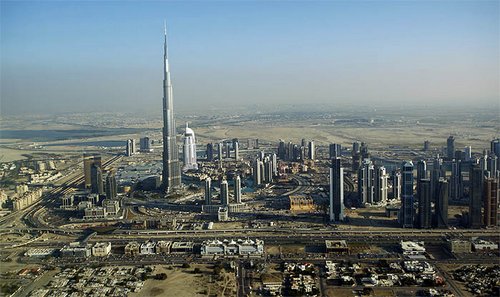
Even with an address at the iconic Burj Khalifa, rents for residences in the tower are not immune from Dubai's real estate crash. Indeed, nearly a year after it was inaugurated with a massive water-and-fireworks display, about 825 of the tower's 900 ultra-luxury apartments remain unoccupied, according to Better Homes, a realestate brokerage in Dubai.
The cost of renting a studio with floor-to-ceiling windows, marble fixtures and wooden floors has dropped to $1,815 a month from $3,025, while a one-bedroom apartment is available for $2,722 (it used to be $4,536), the brokerage says. Two-bedroom residences are expected to get $4,310, down from $7,183. Interested parties "call every few days and go for a viewing," says Imad Ben Khadra, a Moroccan expatriate who owns two 1,000-sq.-ft. one-bedroom apartments he purchased in late 2008 for about $950,000, both of which he is trying to rent out. "We got some offers [from prospective tenants], but nobody confirms." (See pictures of the Burj Khalifa, the tallest building in the world.)
Varun Chaudhary bought two two-bedroom residences in the Burj for about $1.5 million in 2005 even before construction began. He saw the value leap from $762 per sq. ft. to $3,811 per sq. ft. at the heights of the boom. Today, those values hover just above his purchase price. But he says he isn't worried about his investment. "These properties will recuperate faster than other properties because it's an icon, because it's only one in the world," he says. "You just have to say 'Burj Khalifa.' That's the address; you don't have to explain. It's a style statement in itself." (See how the U.S. is leaning on Dubai to pressure Iran.)
Still, the Burj, with its one-of-a-kind address and amenities like the first-ever Armani Hotel, is only the most high-profile example how Dubai's once flying real estate market has crashed. Overall in the emirate, property prices have dropped an average of 50%. Some half-built projects, located away from the main highway that runs through the city, may never be completed because their values have dropped too much, analysts say.
But it's the units that will be completed that are looming as a problem. The Dubai economy must still digest a flood of housing units coming on line or soon to be opened, which will further dampen prices. Through September, 27,000 residential units have been put on the market, and another 9,000 are expected to be completed by the end of the year, according to real estate firm Jones Lang LaSalle. For 2011, the firm forecasts that about 30,000 new units will come on line. A glut in commercial property has forced landlords to offer previously unheard-of incentives such as free rent and allowances to finish out shell construction space. "They built the infrastructure for a much larger economy than it can [now] attract," says Wissam Haroun, a Syrian expatriate who owns entertainment and technology companies in Dubai. (See pictures of Dubai.)
Worried about the glut, Dubai's Real Estate Regulatory Agency recently said it was canceling or in the process of canceling about half of all projects registered with the authority. Of about 980 developments, 495 are on the chopping block, according to a Dubai sovereign-bond prospectus made public last week.
Some, however, see opportunity in the depressed prices. "It's a massive change in terms that it's no longer the man on the street or the lady on the street buying property on spec or off plan," says Paul Devonshire, a director with Pramerica Real Estate Investors who specializes in the Middle East and North Africa region. Now, he explains, institutions or more savvy investors are moving in, eyeing distressed or repriced assets.(Comment on this story.)
But the buzz was decidedly subdued at the recent Cityscape Global, the annual real estate exhibition that in the past featured the launch of glitzy projects like the Palm Trilogy, the world's largest man-made islands. The name of the event itself had been changed from Cityscape Dubai in order to expand the focus beyond the city-state. Only a fraction of exhibitors - 200, down from around 1,000 during the boom - showed up to participate.
With speculators gone and credit still tight, Dubai is going about the hard work of adjusting to its new economic reality. Top of the list is paying back creditors that helped finance the boom. Over the past decade, Dubai amassed $109 billion in debt, with about $15.5 billion due this year, the International Monetary Fund estimates. Dubai World, one of the three main holding companies controlled by Dubai's ruler, Sheik Mohammed bin Rashid al-Maktoum, said last month that 99% of its creditors had agreed to alter the terms on $24.9 billion of its debt. Last November, Dubai World sent stock markets around the world tumbling when it announced it wanted a moratorium of its debts. "We are back. Of course we are back," Sheik Mohammed said in a Bloomberg TV interview last month while attending the Alltech FEI World Equestrian Games in Lexington, Ky.
But, having been through the financial volatility, few seem to want to part with their cash just yet. The Syrian expatriate Haroun, who has lived in Dubai most of his life and plans to raise his family there, says he would like to buy a home. But his forays into the market so far have left him unsatisfied. "People got stupid rich and stupid poor at the same time," he says. "I'm glad I stayed out of it."

Mileage Kings


Stretching your fuel mileage saves time and money. Not only that, but it also limits your exposure to the inconveniences sometimes associated with filling up—grime-covered pump handles, bad coffee, congealed hot dogs, maybe even a bathroom key attached to the hubcap of a 1978 Ford Granada. Indeed, you and your car are at the mercy of wherever you happen to be when the fuel gauge needle hits empty.

Hybrid cars and trucks get plenty of attention for their miserly fuel economy. But there is more to a vehicle’s driving range than impressive mpg numbers. Fuel economy, curb weight, vehicle size, and the volume of the fuel tank all determine how far you’ll be able to travel between pit stops. Of course, a “compact” car doesn’t necessarily mean frugal. The 670-bhp Lamborghini MurciĆ©lago, for instance, is technically a compact, thanks to the dimensions of its cozy 2-passenger cockpit. But this supersonic Italian sports car has an estimated driving range of only 290 miles in combined city and highway driving. Put this $450,000 beauty in your garage, and you’ve bought a long-lasting friendship with your local gas station attendant.

Generally speaking, a smaller car has a smaller fuel tank. This disadvantage is usually offset by a smaller (i.e. more economical) engine. In the case of hybrids, a combination of an electric motor and gas-powered engine work together to boost range and mileage. But are hybrids the default choice when it comes to waving goodbye to frequent fill-ups? What are the options for car buyers who put a premium on driving range?

Here’s what we discovered:

2011 Toyota Prius and 2011 Toyota Camry 4-cylinder

2011 Toyota Prius and 2011 Toyota Camry 4-cylinder
The 2011 Toyota Prius hybrid is the automotive darling of the green car world. Its unique styling and bevy of clever fuel-saving features make this midsize 5-door the benchmark for all other hybrids. Powered by a 1.8-liter 4-cylinder gasoline engine and an electric motor, the Prius offers a total of 134 bhp while returning fuel mileage of 51 mpg city/48 highway/50 combined. Based on the combined rating, expect to put about 595 miles on the odometer between each refill of the 11.9 gallon tank.

In comparison, a 2011 Toyota Camry powered by 2.5-liter 4-cylinder gasoline engine and 6-speed automatic transmission has a combined EPA rating of 26 mpg, which translates to a driving range of approximately 480 miles before the 18.5 gallon tank (6.6 gallons larger than the one in the Prius) runs dry. This gives the Prius a handy 115-mile range advantage over the most frugal Camry – and a point for a pro-hybrid crowd.

2011 Honda CR-Z and 2011 Honda Civic Coupe

2011 Honda CR-Z and 2011 Honda Civic Coupe
The 2011 Honda CR-Z is out to prove that hybrids can be as fun to drive as they are frugal to run. This sleek 2-passenger subcompact is powered by a 122-bhp 1.5-liter 4-cylinder gasoline engine coupled to an electric motor—the battery pack is located beneath the cargo floor. The CR-Z has sharp looks and nimble handling, much like its spiritual successor, the Honda CRX coupe. Straight-line speed isn’t earth-shattering but, all things considered, this is one very fun and economical little coupe.

Yet the tight packaging of the tiny CR-Z puts a crimp on driving range. A CR-Z equipped with a CVT automatic transmission returns an official EPA fuel economy rating of 31 mpg city/37 highway. With its 10.6 gallon tank (and an EPA combined rating of 37 mpg), the CR-Z manages 392 miles between fuel stops. That’s only 9 miles better than the 383-mile range you’ll manage in a 2011 Honda Civic Coupe in DX trim, which has an EPA combined rating of 29 mpg and a 13.2-gal. fuel tank. Motivated by a 140-bhp 1.8-liter 4-cylinder gas-powered engine with a 5-speed automatic, the Civic has room for two additional passengers and, in lower trim levels, costs significantly less than the $19,950 base price of the CR-Z.

2011 Audi A3 TDI and 2011 Audi Q7 TDI

2011 Audi A3 TDI and 2011 Audi Q7 TDI
In the world of diesels, size matters when it comes to driving range—although not in the way you might expect. Take the 2011 Audi A3 TDI, a handsome compact 5-door hatchback with a 140-bhp 2.0-liter 4-cylinder turbodiesel engine under the hood and a smooth-shifting 6-speed automatic transmission that makes excellent use of the available power. The front-wheel-drive A3 TDI is a genuine delight to drive on a winding road. Its economy also makes it the scourge of gas station franchisees. The A3 TDI offers fuel economy of 30 mpg city/42 highway, with a combined rating of 34 mpg. This is especially handy since filling up with diesel isn’t always the most sanitary experience—wash your hands afterwards or you might smell like a tanker truck.

Even more impressive is the A3 TDI’s combined driving range of 496 miles, thanks in part to a 14.6-gal. fuel tank. This range can stretch upward of 600 miles if most of your motoring is done on the highway. Sounds great, except the A3 TDI has a big brother that manages an even more impressive bladder-bursting driving range. The 2011 Audi Q7 TDI doesn’t come cheap; with a base price of $51,775 it costs roughly $20,000 more than an A3 TDI. You’ll also get more power, luxury, cabin space and Audi’s signature Quattro all-wheel-drive system. The EPA fuel economy of 17 mpg city/25 highway (20 combined) may not be all that impressive, until you couple it with the Q7’s mammoth 26.4-gal. tank. This makes for a combined driving range of 528 miles…or a whopping 660 miles of all-highway driving.

Last year's moonshot splashed up lots of water

LOS ANGELES – When NASA blasted a hole in the moon last year in search of water, scientists figured there would be a splash. They just didn't know how big. Now new results from the Hollywood-esque moonshot reveal lots of water in a crater where the sun never shines — 41 gallons of ice and vapor.

That may not sound like much — it's what a typical washing machine uses for a load — but it's almost twice as much as researchers had initially measured and more than they ever expected to find.
The estimate represents only what scientists can see from the debris plume that was kicked up from the high-speed crash near the south pole by a NASA spacecraft on Oct. 9, 2009.
Mission chief scientist Anthony Colaprete of the NASA Ames Research Center calculates there could be 1 billion gallons of water in the crater that was hit — enough to fill 1,500 Olympic-sized swimming pools.

Battling the Earbud Blues


The New York Times
Do you have trouble making iPod earbuds stay in your ears? Does the least bit of exercise make them fall out?
Do you suffer from crippling anxiety because you're the only one in the room who can't manage the simple act of wearing earbuds?
More from NYTimes.com: 

• Group Texting That Appeals to Adults 

• Animation in Starts and Stops, Simplified 

• Will Apple's Culture Hurt the iPhone?
You are not alone. You, like thousands of other Americans, suffer from Earbud Cartilage Deficiency Syndrome (E.C.D.S.). A Google search for "can't wear earbuds" returns only 93,800 results, but when I asked my Twitter followers who else had this problem, tons of them chimed in. (Yes, that's the kind of rigorous scientific research I do.)
If you are small of ear, you may find that those one-size-fits-all earbuds simply don't fit. They're too big -- or you're too small -- for satisfactory wedging.
Yet the cartilaginously well endowed may be E.C.D.S. sufferers, as well. Too big a socket, and those hard plastic discs, ungripped, simply fall out.
Or, like me, you might have been born without an antitragus. That's the little lower-edge wall of cartilage that would hold earbuds in place. (I never knew of my hideous deformity until the invention of the iPod.)
Fortunately, there is hope. Treatment comes in all shapes, sizes, designs and materials. Indeed, these alternative earbuds may even appeal to the normal-eared, because let's face it: standard earbuds can be uncomfortable. They are three things that your ears are not: hard, perfectly round and uni-size.
Here are the four categories of E.C.D.S. solutions. (I didn't consider full-cup headphones, on the premise that they would diminish your reputation in public even further.)
buds1.jpg
Devices for a better fit: (from top) the Earbudi, Comply foam tips and Yurbuds silicone covers.
Earbud Grippers
The first approach is to fasten something onto your existing earbuds to make them grippier or more comfortable. Like EarBudis ($10), for example. (It's pronounced "ear buddies." Ear booties would be something else altogether.) They're rubber over-ear hooks that snap onto standard Apple earbuds.
They do hold up the earbuds, but do nothing for their hard, round bigness. If they weren't comfortable before, they won't be now.
Comply Whoomps ($20 for two pairs) are narrow foam cylinder extensions for your existing earbuds. Again, the idea is to grip your ear canal more strongly without making you buy new earbuds. Unfortunately, although the foam is grippy, it becomes uncomfortable quickly.
Yurbuds ($20) are curved silicone funnels that snap onto standard cheapo earbuds. They make the earbuds softer, increase their grip and enhance the audio. You're supposed to send a photo of a quarter next to your ear so that you order exactly the right size. They work great. However, for the antitragus-deprived even Yurbuds aren't fallout-proof.
Built-In Hooks
Another solution: earbuds with built-in, over-ear hooks. (They may interfere with glasses.)
buds2.jpg
Over-ear styles include (from top) the Philips SHQ300, Sony's MDR AS20J and Bang & Olufsen.
Philips SHQ3000's ($16) are bright orange waterproof earbuds. You can run in the rain, you can rinse them under the faucet, and you can sweat enthusiastically without short-circuiting. They come with a clothes clip (reduces cable strain so they won't yank out), a carrying case and comfortable rubber-dome earbud tips in several sizes. Too bad the sound is so muffled.
Sony's MDR J10 earbuds are even cheaper: $8. Sure, they're chintzy plastic. But they hook nicely over your ear, positioning the integrated speaker bud without any cartilage assistance. The sound is surprisingly crisp and rich; you'd never guess they cost $8. (You'd guess $11 at least.)
Sony also makes the MDR AS20J ($13), whose black rubber "hook" doesn't go just over your ear -- it's kidney-shaped, so it goes all the way around. This design is ideal for the antitragus-challenged; heck, these would stay on even if you were also missing your tragus, scapha, concha and earlobe. They sound easily as good as the regular iPod earbuds.
Bang & Olufsen's earhook earphones ($160) aren't nearly as successful. They're stylish, of course, and they adjust in three ways: the hook opens and closes, the earbud slides higher or lower, and the earbud rotates in or out. But the actual buds are hard, round disks like iPod's, so they're not comfortable. They also take a lot of fiddling to put on.
Headband Style
Sony's streak of successful cheap plastic continues with the MDR AS35W ($20). It's a foldable headband that bends the earbuds right into your ears. Incredibly lightweight (and cheap-feeling), they're incredibly comfortable, and they would stay on even if you had no ears at all.
In-Ear
Audio aficionados reject the standard music player earbuds not because they fall out, but because they're cheap and don't sound very good. They'd much rather buy in-ear earphones, whose rubber or foam tips wedge all the way inside your ear canal.
That design does more than prevent fallouts. It also blocks external sound, giving you a bit of noise reduction on, for example, plane rides (and making them more dangerous for biking and jogging). And by sealing your ear, these deliver far better sound.
buds3.jpg
The in-ear style of the Etymotic HF3 (top) and Klipsch X10i also help to block street noise.
Each type comes with different tips: silicone domes, triple-flange stoppers, foam cylinders and so on. The hope is that you can find a tip type that feels comfortable for long hours and still seals your ear.
In-ear phones can cost more than the music player itself -- but that's no deterrent to music fans. It's like a photographer buying a lens that costs more than the camera.
The price range is enormous. Skullcandy has a whole range of inexpensive in-ears, like the 50/50 ($45). They come with a cool, colorful and fabric-covered cord, playback/volume controls right on the cable, three sizes of tips and even a microphone for use with the iPhone or iPod Touch. Unfortunately, the sound is nothing like what you'd get with the more expensive in-ear types.
In creating its Metal Remix Remote ($70), V-Moda pulled out all the stops to keep them on your head. You get four sizes of tips, a shirt clip and even optional over-ear hooks. (The hooks have "Active Flex technology," which, as far as I can tell, means they're a little bendy.) The only thing that would do a better job of keeping these earbuds in place would be Super Glue.
Handily enough, you get playback and volume controls on the cord, too.
The Etymotic HF3 ($180) also has cord controls -- and a microphone. These come with a bunch of tips, and you can also pay $100 more to get custom-fitted tips that are molded (by a local audiologist) to your exact ear shape.
My favorites were the Klipsch x10i. Yeah, they're $350, but they sound absolutely amazing; at half volume, you get the same sound you would at full from lesser buds. You get five sets of tips, cord controls and a shirt clip. The tips are oval instead of round, and therefore extremely comfortable.
Online, people rave about the amazing sound of the Shure SE 535 in-ear buds ($450 -- ouch). They include playback controls on the cord and a whole farmer's market of tips: triple-cone, yellow foam cylinders, and five sizes of black silicone. The first inches of the cord are bendable, so that you can hook them over the tops of your ears. Oh, and they come in a gorgeous aluminum box.
These phones feature "Triple High-Definition MicroDrivers." Whatever that means, this extra gear occupies a little lima-bean of a body that's supposed to nestle in (sigh) your antitragus. Basically, I could not make these things stay in, and it's fussy to have to thread the cords over your ears.
If you, too, suffer from E.C.D.S., solutions are at hand. If the problem is ear deformity, Sony's over-ear, around-ear or headband-style earphones are dirt cheap and sound surprisingly good. If the problem is the discomfort or size of hard, round earbuds, consider the Yurbuds or in-ear types like the Skullcandy, V-Moda or Klipsch models. You'll face the unafflicted population with head held high, proud to have overcome your disability and entered the mainstream at last.
___ 

Tigers could be extinct within 12 years: WWF


STOCKHOLM (AFP) – Tigers could become extinct within 12 years but a top level meeting in Russia next month could help reverse the decline, nature conservation body WWF said on Thursday.
"The worse scenario is that the tiger could be gone when the next year of the tiger comes along, in 12 years," said Ola Jennersten, head of the international nature conservation programme at WWF Sweden.
The organisation is leading a global campaign to attempt to double the number of tigers by 2022, when the next Chinese calendar year of the tiger comes around.
WWF said that in the last century, illegal hunting, a shrinking habitat and the trade of tiger parts used in oriental medicine had sent the number of the big cats worldwide plunging 97 percent to around just 3,200 tigers today.
"Despite the gloomy figures, the situation is more hopeful than ever," Jennersten said, praising a political initiative of 13 'tiger states' and different bodies set to meet in Russia on November 21-24 in a bid to halt possible extinction of the species.
"This will be achieved through increased political involvement, focus on the tiger landscapes that have the greatest chance of long term retention of the tiger, and increased control of tiger trade," he said.
Russian Prime Minister Vladimir Putin, who in the past years has made a big show of his love for nature, publicly kissing animals and engaging in a string of stunts involving wildlife including tigers, is expected to attend the summit in Saint Petersburg.
WWF said some 1,800 tigers live in India, Nepal, Bhutan and Bangladesh, 450 live in Sumatra, 400 in Malaysia, 350 are spread throughout southeast Asia and around 450 live in the wild in Russia.